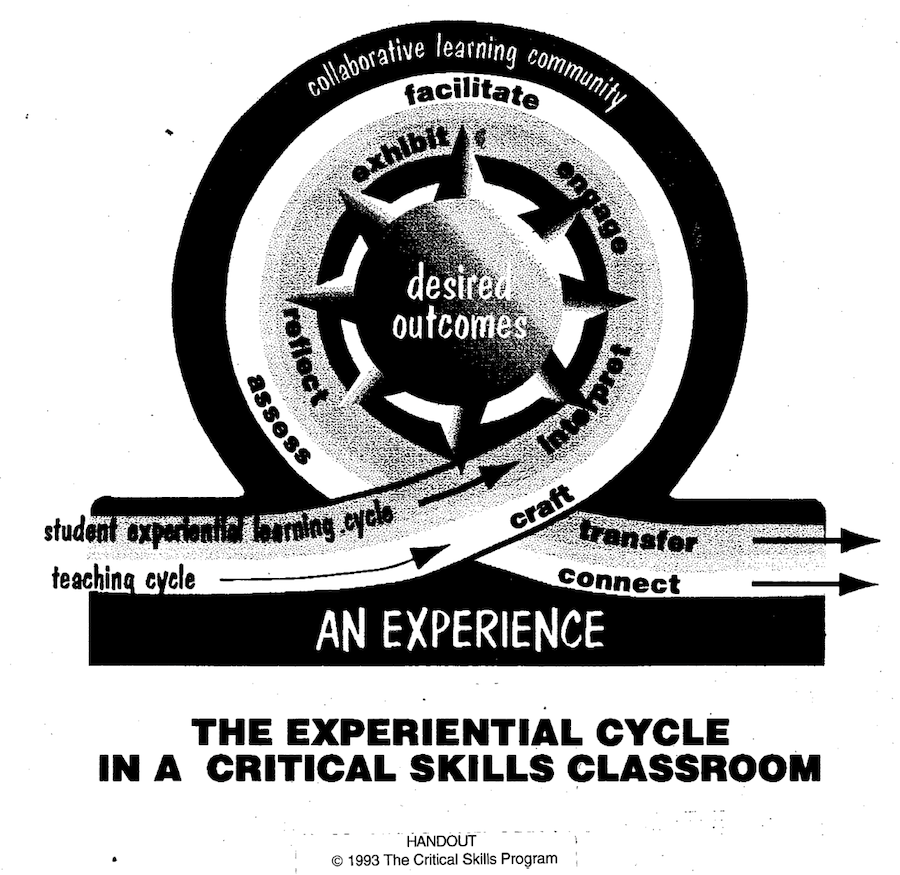
As part of this year’s celebration of 40 years of the Critical Skills Classroom, I’ve been looking back through the archives. I’ve spent time with books, articles, tools, newsletters, photos, challenges (written by hand or typed on electric typewriters!), correspondence, and meeting minutes from the days before the internet.
Each references the best thinking of the day, the emergent research around learning, technology, nature, neuroscience, and collaboration, filled with citations- educators and authors who were thinking, observing, connecting, and exploring— documenting what they were learning so that others could stand on their shoulders.
Four decades of teachers turning theory into practice, creating tools and strategies that teachers could use on Tuesday, rooted in the big ideas of the day. Designing challenges that bridged the ever-evolving needs of communities and the things we most wanted our students to know and do, while also respecting the goals and needs of the teacher as a co-learner.
The whole thing has taken a very If You Give a Mouse a Cookie sort of turn, as I find myself revisiting the voices that underpinned the work in 1986, 1993, 2001, and 2015. Some are familiar and some are new, and (as often happens at this stage of my life,) I think some are new until I start reading, only to remember that they’re actually familiar.
Or, as Ralph Waldo Emerson mused,“I cannot remember the books I’ve read any more than the meals I have eaten; even so, they have made me” –
Last month, I asked you to think about the people who shaped you into the educator you are today. I’m a big fan of reflection, so why not repeat the exercise? What do you recall about the books that made you?
- What did they teach you?
- How do you aspire to embody them?
- Why were they important to you?
- What if you’d never crossed paths with them?
And don’t think it’s only about the professional books. I believe that we’re better teachers for the time we’ve spent with Pip, Katniss, Starr, Gatsby, Esperanza, Bilbo, and Percy. This month, I’m sharing my favorites- the books that made me- along with some lists that can help you find your new favorite read (or your new favorite listen!)
It only seems fair that I share the books that came to mind for me.
- 900 Shows a Year—Stuart Palonsky – Taught me that teaching is about more than knowing your content and caring about kids
- Inside Out: Developmental Strategies for Teaching Writing (2nd Ed) —Kirby and Liner- Gave me a whole new way of thinking about writing- as a teacher and as a writer
- Horace’s Compromise — Ted Sizer- Got me started thinking about how schools could be different (I was in 12th grade when I read it!)
- The Power of Their Ideas—Deborah Meier- Reminded me that kids know a lot more than we give them credit for.
- Why Are All the Black Kids Sitting Together in the Cafeteria? —Beverly Daniel Tatum- Where do I start? I’m a white lady now and I was a white girl who grew up with white people. This book was the first of many that helped me understand what that meant.
- Teaching As a Subversive Activity—Neil Postman- I came to this one later than I wish I had, but it’s probably more important now than it was when it was published.
- Jacob Have I Loved —Katherine Paterson- Perspective, perspective, perspective.
- True and False: Heresy and Common Sense for the Actor—David Mamet- Be present. Be authentic. Respond to what’s actually happening, not what you think or expect (or fear) is happening.
- The Princess Bride— William Goldman- Being silly and having fun can be serious undertakings.
I’d love to hear from you. What books (or movies or songs) come to mind when you think of how you became the person (and the educator) you are today?
Best-
Sign up for Connections: Tools, News, and Inspiration for Teachers Like You and receive these little letters (plus a lot more) straight to your inbox every month!